Friday, August 2, 2013

Riding the Rails of the Alaska Railroad


We departed the Island Princess at 7AM for an eight hour train ride to Denali National Park.  Our
eight hour train ride included riding in a double decker train with a glass roof.  During the long train ride we passed a lot of scenery with lots of beautiful ponds with birds and waterfowl, deep gorges cut by rivers, with fireweed and cow parsnips lining the tracks along the way.  Each domed window car had its own personal conductor who would provide information and stories about the areas as we passed. 
Tony opted instead for the “lounge area” on the lower level which allowed us to spread out a little more, but we lost the view provided by the upper compartment.  However, I discovered a smoking area in the back of our train car where you could go outside to smoke or take pictures.  They really needed a “photo area” because that’s what most of the people were doing and we needed to get rid of the smokers! 
Dinner Plate Dahlias
Just past Anchorage on the tracks, we passed thru Wasilla.  As the train made its way through the 6th largest city in Alaska, we learned interesting facts, like the Wasilla sits in the bread basket area of Alaska.  Stuff just grows big in Alaska, big bears, big fish, big flowers and world-record holding jumbo crops including a 19-pound carrot, a 76-pound rutabaga and a 127-pound cabbage.  Their State Fair must be incredible.  The 20 hour days evidently more than makes up for their short growing season.

Duct tape decorated moose
Of course everyone knows what Wasilla is really known for.  You got it-duct tape!  The Walmart in Wasilla is world famous as the duct tape capital of the world.  http://www.octanecreative.com/ducttape/wasilla/  Alaskan’s buy and use more duct tape for everything from creating art, patching planes or using it for medical purposes if no doctor is handy.  The Mt. McKinley Princess Lodge had its own duct tape Moose, proving how versatile duct tape can be.  As we passed by the Wasilla Walmart,  the day was very clear.  I swear I could see Russia from the parking lot!   
Dall Sheep along side the tracks near Turnagain Arm.  Too bad
they wouldn't smile for me!
Out in the “photo area” I ran into Gina who I had met the first day on the cruise.  We were both attending a photo seminar on the Island Princess; trying to get the most out of our cameras and we exchanged some tips afterwards.  We exchanged itineraries and we were both bound for the Denali Princess Lodge.  She was traveling with her husband and son, Tony and Tony and they lived in Connecticut.  We spent hours on the outside platform comparing photos, cameras and life, all the while taking photos when something interesting passed by.  That really helped make the 8 hour trip go a little faster.
Beautiful scenery along the way to Denali
Shortly before we made it into  the station, Aliy Zirkle came into the car to talk about her experiences with the Iditarod race, which starts in Seward and ends in Nome Alaska; an 1150 mile trek.  The Iditarod gets its origins from a medical crisis.  In January 1925, doctors realized that a potentially deadly diphtheria epidemic was poised to sweep through Nome’s youth.  The only serum that could stop the outbreak was in Anchorage, over a thousand miles away.  The only plane in the area was not operational.  Twenty  individuals volunteered to transport the vaccine to Nome the old fashioned way via dog sled, to save their neighbors from an epidemic.  The route the couriers had to travel to Nome was in the dead of winter over frozen water and through a whole host of mountainous terrain in sub zero weather.  They did so in record time of 6 days and were able to save the community. http://en.wikipedia.org/wiki/1925_serum_run_to_Nome  In commemoration of the race, pitting man and dog against nature, the Iditarod race was started.  However, rather than 20 mushers, each team of dogs is operated by a single musher.  Men and women compete against each other, hoping to win the coveted title in a race that can take between 8 - 11 days. 
Trumpeter Swans and four babies 
Aliy Zirkle has run the race for 13 consecutive years and has come in 2nd the previous two years, being in the leading position until late in the race.  She also raced in the lesser known Yukon Quest, a 1,000 mile race in February and won it in 2000.  She figures that to come in first next year, her dog team just needs a little more exposure and encouragement so she was passing out literature to spread the word and asking people to visit her site; http://www.spkenneldoglog.blogspot.com/ .  I just checked on it when I got home and they had pictures of the cutest little puppies that were just born in July.   Check them out!
Welcome to Denali
As we made our way into the station, all the lodge transportation crew were there waving to us with the Disney “Princess Wave”.  A nice welcome to Denali.


Thursday, August 1, 2013

College Fjord and Whittier


The last full day of our cruise we sailed to College Fjord.  It took until almost 5:00 PM to reach the
At the end of the Fjord, eight glaciers are visible at one time, making for wonderful scenery. 
http://www.gibbworld.com/glaciers/collegefjord.html.  Also since our arrival time was late in the afternoon, the sky was a perfect shade of blue and the sun was shining brightly.  No complaints here, finally! 
 

The most impressive is the Harvard Glacier, which has a perfect example of the raceway curves of

Harvard Glacier
Yale Glacier
 
 
Closeup of Yale Glacier


dirt and
rock running the length of the glacier.  If the glacier was prone to calving, there was little activity the day we were there.  The other glaciers there also had very little calving activity.  However, we were able to see harbor seals for the first time and they seemed perfectly happy to bask in the sunshine keeping cool all the while by laying on top of an iceberg. 


We spent several hours cruising and observing the glaciers, other than 5 seals, a few otters and one humpback whale, the wildlife was not as plentiful as the day before.   Which really translates to-Tony and I could eat at a reasonable time since I wouldn’t be looking for whales to take pictures of!   Since sunset was close to midnight, Tony and I also had the rest of the evening to relax before departing the next morning. 


Princess photo crew took to the waters to photo passengers
from their cabins.  They stopped to investigate an iceberg.


Tony even went to bed early, but as I was scrolling through my thousands of photos, I saw the scenery from our balcony coming down the bay to Whittier where we would dock around 1 AM.  The scenery was fantastic, waterfalls appeared to be falling from the sky, glaciers so close, I thought I could reach out and touch them,  It really made me regret that we came in around dark.  But it is never really dark in Alaska, so after waking Tony up, we went up on deck to view the beautiful scenery and watch the docking process in Whittier.  There were only a couple other crazy fools out there with us.  Unbeknownst to all the other passengers, they were missing one of the best scenery opportunities of the cruise.  Finally about 1:30 AM we headed off to bed, trying to get some sleep before our 7 AM departure for Denali.
 

Whittier as we pulled into dock.


Wildlife Along the Inside Passage at Glacier Bay and College Fjord

Against the face of the Margerie Glacier where the glacier melt exits beneath the glacier we saw hundreds of seagulls.  I can only surmise that the waves and broiling water exiting the glacier helped bring small fish to the surface producing a smorgasbord for the birds.  There also were small puffins that fished in the area.  This was our first encounter with these colorful birds that are very comfortable in the water and swim as
Puffin in flight.
efficiently as penguins, diving over 200 feet deep in search of food.  When trying to take off, the puffins appear to be running on water, as the below photo illustrates.  We heard that if they ate too much, sometimes they are unable to fly, either too heavy or too full, not sure which!


Puffin on the run.  He's like the little engine that could!  I think I can, I think I can!

In Glacier Bay we had our first encounter with sea otters.
 
Sea Otters waving.


They have to be the cutest things I have ever seen, we instantly fell in love with them.  However, it is a little difficult to take good wildlife pictures when you are on a 14 story ship.  I took many of the pictures of birds and sea mammals from the 11th floor and I’m rather surprised that I had any of them in focus at all. 
The Otter Flotilla
Sea Otters however were a little difficult capture as are smaller, usually further away from the ship; they float, turn, dive and just seem to be having a great time playing in the sea and avoiding getting their picture taken! 


Clapping otter


However, the most elusive of all the wildlife were Dall's Porpoise.   They are the fastest little suckers I have ever seen!  By the time you know they are there, the speed demons are either gone or just leaving you with a splash, definitely not easy for a DSLR.  They travel at up to 35 mph and can reach 7.5 feet.  Their coloration looks like a miniature orca, just 10 times smaller and faster.  While I saw them many times on the trip, I only had one or two shots of anything that looked like more than a splash.    I have a lot of respect for anyone who can take good pictures of them!


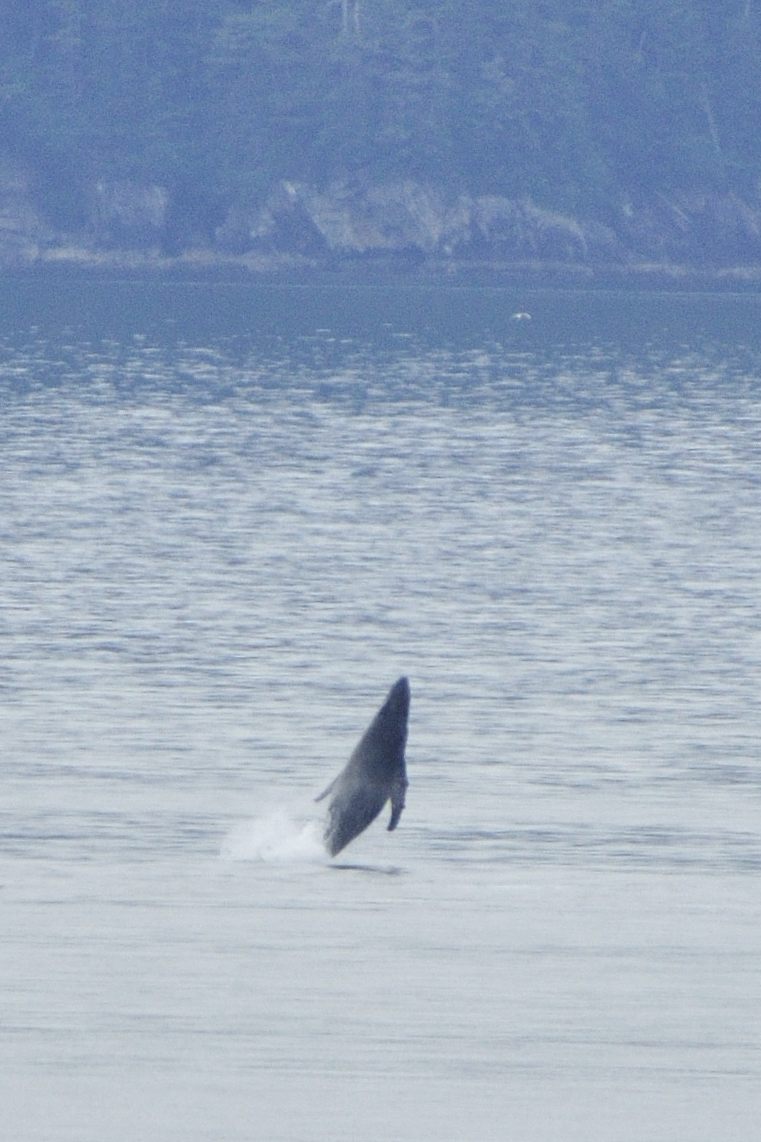
 Later that day as we were exiting Glacier Bay, we sighted many humpback whales.  There appeared to be a confluence of waters that must have been full of krill.  There had to be 30 -50 whales that
were feeding along the line of where the two waters met.  Off in the distance the whales were spouting and breaching; throwing their entire bodies out of the water.  Adult Humpback Whales are 45 feet long and average 1,000 pounds a linear foot.  It takes a huge amount of effort for them to breach out of the water.  There were numerous chances to observe the fluke, or whale’s tale as they were repeatedly diving as they fed in this krill rich area.  There was a small boat that was on a whale watching cruise that was nearby and they must have had a fabulous show!
 
That must have been an amazing sight from that little boat.

Whale in a full breach.  Glad that 45,000 lbs isn't landing near me!


Momma's Fluke and baby whale following
In College Fjord we again saw otters, gulls, a lone humpback whale and had our first look at harbor seals.  We saw a group of five of them floating by on an iceberg at the end of the fjord.  They seemed to be quizzically watching the passengers on the ship as they floated by.  Evidently seals and their pups are safe inside these tidal areas filled with icebergs.  Their primary threat comes from Orcas who avoid hunting in these areas because the icebergs confuse their navigation. 

I knew that we would be again passing those cute seals on the iceberg on our way out of the fjord.  I was hoping to get a closer angle, so with camera and 500 mm lens in hand, I made my way to the 7th floor deck in search of a great seal shot.  Not sure what side of the boat they would be on, I was running from side to side and eventually saw them approaching very close to the ship on the “starboard” side, that’s the left side for all you land lovers.  I ran (and I can’t run) as far down the deck as I could to get a good spot and then took as many pictures as I could before we sailed past them and they were out of view.  I swear they were watching me running around with my monster lens wondering what the heck I was doing!

Over the two days we cruised the two glacier areas we saw almost all the water mammals that I would expect to see except Orcas.  I only saw one on the trip and that was near Vancouver and very far away.  We never did see a bear on the trip, but that was not too unexpected.  I'm sure we will see some in Denali and of course we were guaranteed to see them at Brooks Falls.

Day 4 -5 - Crusing Glacier Bay


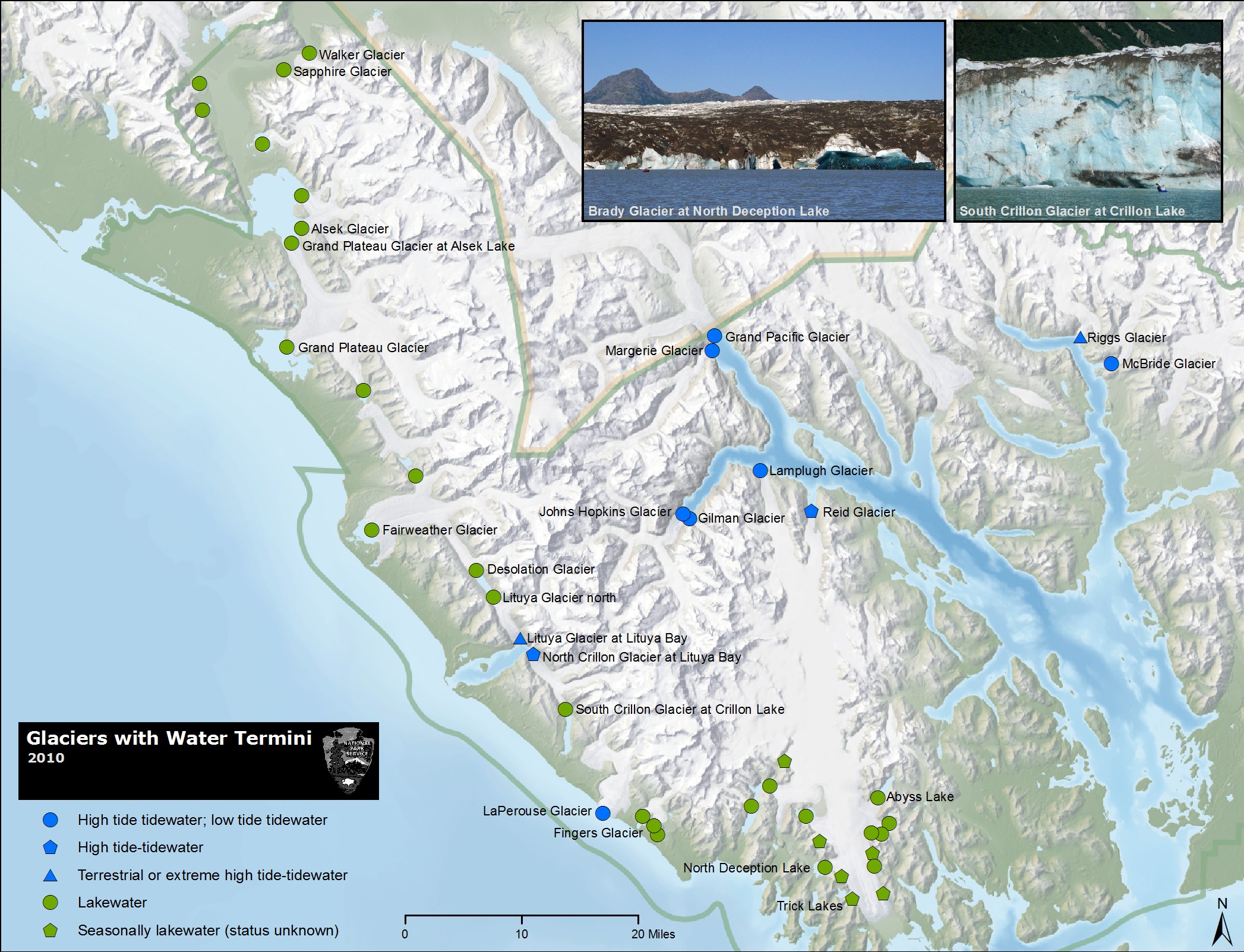
Our entire trip has been planned around visiting two locations, Glacier Bay National Park on the inside passage and Brooks Camp in Katmai, National Park.  Today we start two days at sea, cruising the first day into Glacier Bay and College Fjord the second, both are only accessible by boat.  In 1750 there was no Glacier Bay, but rather it was a single glacier thousands of feet thick which filled what is now a 65-mile long fjord.  Now as the glacier has receded, Glacier Bay National Park has numerous distinct tidewater glaciers that are visible within the bay.  The highlight of the cruise is at the end of the fjord where the Margerie and Grand Pacific Glacier terminate into the sea.  http://www.nps.gov/glba/naturescience/upload/Tidewater-and-Lakewater-Glaciers.jpg  The Margerie Glacier is the most famous and typical of what we think of when we refer to glacier, white ice, blue in the crevasses with dark tracks of dirt and rock.  The Grand Pacific Glacier is the opposite as it appears to be just dirt, but beneath its brown exterior is a core of ice.

It seems that every morning the skies are cloudy and the ceiling low, today was no exception.  However the further we cruised, the lower the ceiling dropped until it almost met the ocean. It seemed like Ground Hog Day, another grey day on the horizon.  If there was one place I really wanted to be sunny on our cruise, it was Glacier Bay, but that was not to be!
  As we cruised past Gustavus, we pick up two park rangers from the Glacier Bay NP ranger station.  They set up a park’s area on board with literature and answered questions as well as provide a broad cast of Glacier Bay facts as we cruised 65 miles into the fjord.  They also were great at alerting us to marine wildlife and glaciers as we cruised past.  The Island Princess is one of only a handful of cruise ships allowed into the bay.  Also there is a limit to the number of ships allowed per day.  

Glaciers are “rivers of ice”.  Snow over the years have accumulated and been compressed into ice.  Tidewater glaciers terminate directly into a water source and there are many visible all along the inside passage.  The glaciers are drawn by gravity down valleys, grinding rock along the way and ultimately emptying into the water.  The glacier’s movement is aided by melted glacial water that runs underneath.

We had a great view from our balcony.
The front wall of the Margerie Glacier is huge, rising straight up 250 feet from bay, with an additional 100 feet under the surface.  The glacier itself is stable, forming as much new ice as it loses in a year.  It is also one of the better known glaciers for its frequent calving.  As the glacier moves, chunks of ice crack and ultimately break off or “calve” into the water.

Notice the smaller ship on the left side of the glacier.  Also notice how large the iceberg in the water is compared to the ship.
  As we approached the face of the glacier there was a smaller glacier tour boat that was leaving the area as we approached.  The ship helped to put the immensity of the glacier into perspective which can be quickly lost without something to compare it to. 
 
Aegean blue ice in the crevasses of the glacier face.
On a sunny day, you would immediately recognize a glacier; its white form with aegean blue ice mixed in with its irregular peaks and crevasses.  Most also have white ice contrasted with lines of dirt and rock running the length of the glacier.  However, on a cloudy day, it is hard to differentiate the clouds from the ice.  Luckily as we approached, the clouds started to rise, revealing the entire glacier as the park ranger narrated over the ships loud speakers.  

Thanks to the Jenkins from Utah for taking this pic.  We kept running into Alan and Lori Ann during the many days of photographing wildlife and scenery from the ship.

Its everyone's dream to see a huge chunk of a glacier crash into the ocean, you know-just like you see in Discovery or Nat Geo Channel documentaries.  Most passengers were on deck and almost as soon as we approached, a humongous crack put everyone on alert.   It almost sounded like the crack of a rifle; the glacier was moving.  As I later discovered, ice doesn’t fall every time you hear a crack.  However, once you hear the crack, it’s usually too late to see the ice falling from the glacier.  A perfect example of how slow sound travels, we were only a half a mile away. 


360 perspective of cruising into Glacier Bay.
We stayed near the glacier of over an hour as the skies started clearing and the glacier had multiple calving events.  Various sized icebergs filled the bay; remnants of previous calving events.  It was really hard to appreciate the size of the icebergs, they looked like little ice cubes floating in the
Even seagulls need a rest.
water.  90% of those were underwater and only 10% showed above.  It wasn’t until you could compare them to a life size object did you realize that some of them were the size of small boats.  Timing is everything and I was really lucky that when the largest piece calved, I had my telephoto lens already focused on that particular area.  There was a large cave at the base of the glacier where large waves were created by water roaring out underneath entering into the bay.  Immediately after switching lens, a huge piece of ice started dropping straight down along the face of the glacier by the cave and fell into the water creating a huge wave and splash.  

 
Glacier starts to calve.


This slice of glacier must be at least 30 feet high and 70-100 feet wide.
 
This was the largest piece that dropped while we were there.


Final crash into the water.  I'm glad I'm not in a kayak near the glacier.

As we turned to leave,  blue sky was just starting to peek through.

Glacier has receded and left the
typical carved valley behind.
 
Luckily most passengers were gone so they didn't think we were too crazy!
  Within a half hour of leaving the end of the fjord, the sky became a glorious blue and the sun shone the rest of the day. 
 
As there were many other glaciers to observe and we enjoyed the beautiful sights along the way. 


Icebergs appearing like ice cubes in the water.
 
Jo Ann's happy with the blue sky!

 As we sailed past Gustavus, the park rangers disembarked and we set sail for College Fjord, our last destination prior to the end of the cruise.
Sun setting over the Pacific around 11 PM.


Massive 14,000' mountains rise up from sea level along the shoreline. 


Closeup of the shoreline.